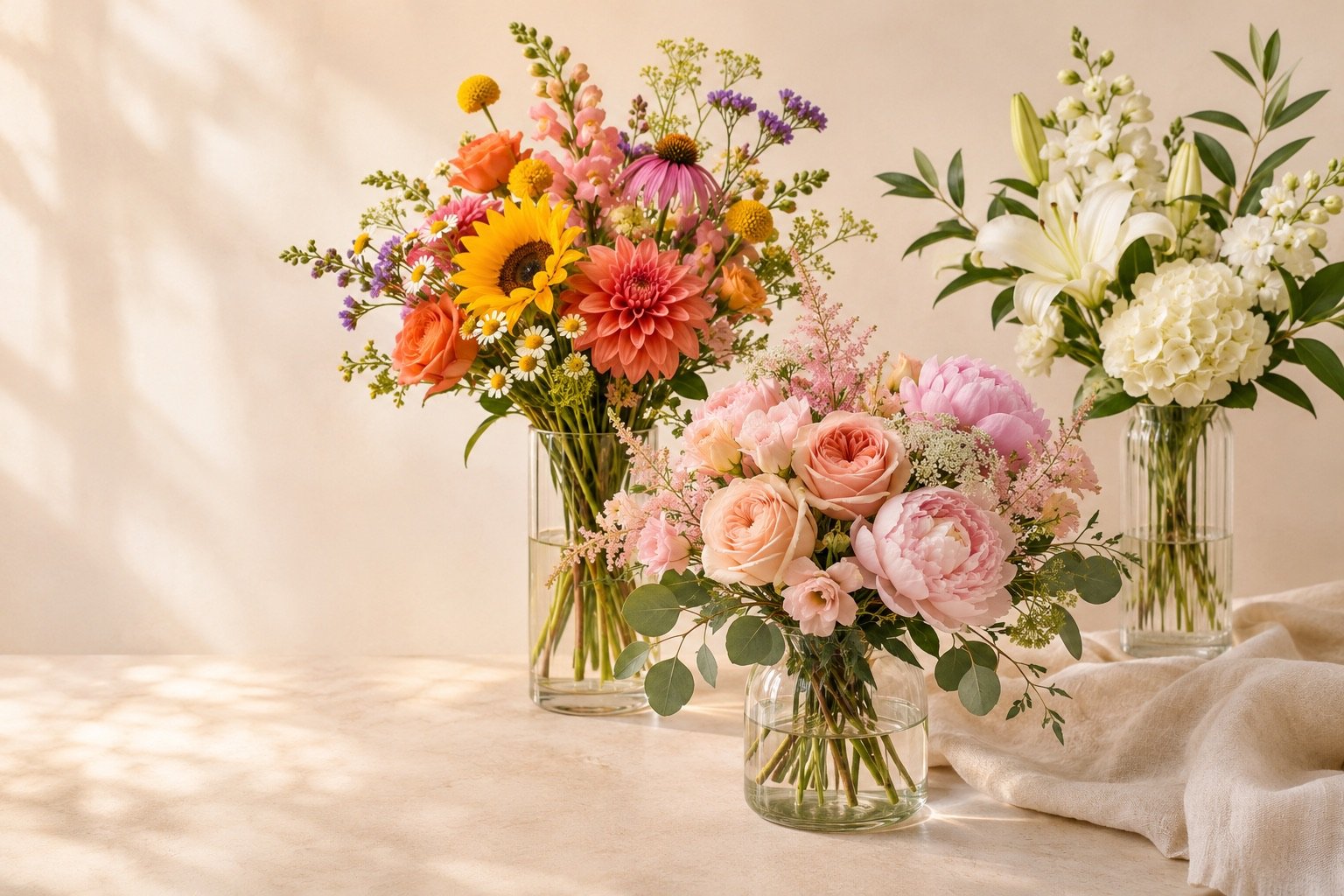
The short answer: Match the bouquet to how the person already dresses, decorates and celebrates. Choose saturated mixed flowers for someone bold, a restrained palette for a minimalist, garden-style texture for a nature lover, elegant roses or orchids for a polished traditionalist, and unusual shapes or color combinations for a creative recipient. Then check the practical details: home size, fragrance preferences, pets and delivery timing.
Personality is a useful shortcut, not a scientific label. The best clue is always something the recipient has actually liked before.
Start with evidence, not a stereotype
Before choosing a “type,” look for three real signals:
- Their visual style: bright or neutral, layered or simple, classic or experimental.
- Their daily environment: large home, small apartment, office, dorm or shared household.
- How they like attention: big public gesture, quiet surprise or practical gift.
Do not assume that women want pink, men want dark colors or older recipients want traditional flowers. Age and gender reveal less than the person's own clothing, home, hobbies and past choices.
If you can answer “What colors do they repeat?” and “Would they want the bouquet to be the room's focal point?”, you can usually make a confident choice.
Quick personality-to-bouquet guide
| Recipient style | Look for | Good direction | Think twice about |
|---|---|---|---|
| Bold and social | Saturated color, strong contrast, generous scale | Bright mixed vase arrangement | Pale, very restrained designs |
| Calm minimalist | One or two colors, clean line, open space | Monochromatic or low-color bouquet | Busy mixes with many fillers |
| Romantic | Soft texture, graceful shapes, personal color story | Roses or a garden-style mix | Defaulting to red without context |
| Creative | Unusual form, asymmetry, unexpected color | Sculptural or high-contrast design | Generic color-by-number bouquets |
| Nature lover | Seasonal texture and less formal movement | Garden-inspired mixed arrangement | Heavy decoration or glitter |
| Classic traditionalist | Symmetry, familiar flowers, polished vase | Roses, lilies or refined mixed bouquet | Trend-led novelty for novelty's sake |
| Cheerful optimist | Sunny colors and easy visual warmth | Yellow, orange or multicolor mix | Somber palettes they never wear |
| Practical homebody | Ready-to-display, manageable footprint | Compact vase or basket | Oversized designs requiring setup |
These are starting points. If the “minimalist” recipient loves sunflowers, send sunflowers.
For the bold, social personality
Choose a bouquet that is easy to notice from across the room:
- Saturated pink, orange, yellow, purple or red.
- Clear contrast rather than many similar pale tones.
- A medium or generous scale that suits the delivery location.
- A ready-to-display vase for an immediate reveal.
Mixed arrangements with sunflowers, roses, snapdragons or other strong focal blooms can create the energetic effect. Exact flowers depend on season and local inventory, so shop the overall palette and silhouette rather than one promised stem.
Best when: they love parties, statement clothing, colorful rooms or being surprised at work.
Avoid: sending a very large workplace arrangement without checking desk space or office delivery rules.
For the calm minimalist
Minimalist does not mean small or impersonal. It means fewer visual ideas, executed clearly.
Look for:
- One dominant flower or color family.
- White with green, soft blush, all yellow or another controlled palette.
- Clean glass or simple ceramic containers.
- Open shapes with visible space between focal blooms.
- Little decorative ribbon or themed ornamentation.
A dozen roses in one color may suit a minimalist better than a complex mixed bouquet, but roses are not the only option. Orchids, tulips when seasonally available or a restrained green-and-white design can feel equally intentional.
Best when: their wardrobe is edited, their home has clear surfaces or they value design over abundance.
Avoid: adding balloons or a plush toy unless they enjoy playful extras.
For the romantic personality
Romantic style is about tenderness and story, not automatically red roses.
Consider:
- Blush, cream, lavender, peach or deep red based on their colors.
- Soft petals and garden-style movement.
- Roses mixed with complementary blooms for a less formal feeling.
- A card that names a specific memory or quality.
For a partner, red can communicate romance. For a friend, relative or coworker with a romantic visual style, pink, peach or lavender may preserve the softness without implying a romantic relationship.
Best when: they love vintage details, keepsakes, handwritten notes or lush interiors.
Avoid: assuming every romantic person wants a relationship-coded message. Occasion and sender matter.
For the creative original
A creative recipient may enjoy a bouquet that feels composed rather than conventional.
Look for:
- An asymmetrical outline.
- Contrasting warm and cool colors.
- One unexpected focal flower.
- Visible texture from foliage, berries or varied petal shapes.
- A color combination connected to their art, studio or favorite object.
The card can explain the choice: “These colors reminded me of your latest painting.” That one sentence makes the gift feel observed rather than randomly unusual.
Best when: they work in design, make art, collect objects or consistently mix colors and patterns.
Avoid: choosing something strange only to prove originality. It still needs to look like them.
For the nature lover or gardener
Choose a design that feels less rigid and more seasonal:
- Mixed heights and natural movement.
- Greenery that contributes to the composition.
- Flowers that resemble a garden gathering rather than a perfect dome.
- A palette inspired by a meadow, woodland or favorite season.
- Minimal synthetic decoration.
Do not claim that a delivered bouquet is local, native, organic or sustainably grown unless the seller provides evidence. “Garden-inspired” describes the look, not the origin.
Best when: they garden, hike, birdwatch or prefer natural materials.
Avoid: a potted plant unless you know they want ongoing care. A birthday gift should not create an unwanted task.
For the polished traditionalist
Familiar does not mean generic when the quality and message are right.
Good directions include:
- A symmetrical rose arrangement.
- A refined mixed vase in two or three colors.
- White and green for understated elegance.
- Pink or peach for warmth without high contrast.
- A classic container rather than a novelty vessel.
Use the recipient's favorite color to personalize a traditional shape. If they always keep blue accents at home, a blue-and-white palette may feel more thoughtful than the most expensive red arrangement.
Best when: they value ceremony, timeless clothing, formal hosting or familiar favorites.
Avoid: forcing a trend when they have a clear established taste.
For the cheerful optimist
Build around visual warmth:
- Yellow, coral, orange, hot pink or a balanced rainbow mix.
- Sunflowers, gerbera-style daisies, roses or other open focal forms when available.
- A transparent vase or casual basket.
- A short, energetic birthday message.
“Cheerful” is about the overall composition, not a guaranteed emotional effect. Flowers cannot promise to improve someone's mood, and a recipient can love bright colors without being constantly upbeat.
Best when: they use color freely, host casual gatherings or enjoy playful gifts.
Avoid: novelty additions that create clutter if they prefer experiences to objects.
For the practical homebody
Prioritize ease:
- A vase arrangement that arrives ready to display.
- A stable container with a manageable footprint.
- Moderate fragrance when sensitivities are unknown.
- A design that fits a kitchen table, sideboard or small apartment.
- Clear delivery timing so the recipient can receive it.
The most thoughtful bouquet may be compact rather than dramatic. Add a card that says why you chose it and skip accessories they must store.
Best when: they value comfort, useful gifts and quiet celebrations at home.
Avoid: loose stems if the recipient does not own a suitable vase or enjoy arranging flowers.
Match the bouquet to how they celebrate
Personality is only half the decision. Use the celebration style as a filter:
They love a big moment
Choose noticeable color and scale. Verify that the venue accepts deliveries and that the recipient enjoys public attention.
They prefer privacy
Send to the home, use a modest ready-to-display design and do not post about it online without permission.
They are traveling
Deliver before the trip only if they will have time to enjoy the flowers. Otherwise schedule after their return or choose another gift.
They are hosting
A compact arrangement can work as décor, but avoid making the host find a vase or clear a large area during preparations.
They do not make a fuss about birthdays
Use a simple bouquet and matter-of-fact card: “Thinking of you today and hoping the year ahead treats you well.”
Choose color from their real life
When you are unsure which flower to choose, decide the color first.
Look at:
- The colors they wear repeatedly.
- Their phone case, bag or water bottle.
- Home accents visible in photos.
- A favorite sports team, garden or travel destination.
- The invitations or decorations they choose for events.
Do not rely too heavily on universal color meanings. Red may feel romantic in one context and simply bold in another. White may read as elegant, peaceful, formal or ceremonial depending on the person and culture. Personal evidence beats a generic symbolism chart.
Questions to ask without spoiling the surprise
Ask someone close to the recipient:
- “What colors are they using at home right now?”
- “Do they prefer bright flowers or neutral ones?”
- “Do they own a vase, or should I send an arrangement in one?”
- “Are strong scents a problem?”
- “Are there cats, dogs or other animals in the home?”
- “Will someone be available to receive a delivery?”
- “Would flowers at work feel fun or embarrassing?”
These questions produce more useful answers than “What is their personality type?”
Safety, fragrance and household fit
Before ordering, check for:
- Pets that may reach or chew the arrangement.
- Young children who may handle loose materials.
- Fragrance sensitivity or migraine triggers.
- Limited counter or desk space.
- Care restrictions in hospitals or care facilities.
The ASPCA maintains species-specific toxic and non-toxic plant information and warns that plant risks vary. If animals live in the home, ask the florist for the complete arrangement contents and verify every flower and greenery item for that species. Substitutions can change what is delivered, so do not call a mixed bouquet “pet-safe” based only on the product photo.
When you cannot verify the contents, send a non-floral gift or arrange delivery to a pet-free location.
How to browse without overfitting the label
Use the personality direction to narrow choices, then compare practical details:
- Filter for birthday arrangements.
- Pick two color families that match the recipient.
- Choose a size appropriate to the space.
- Prefer a container when setup convenience matters.
- Read the description for likely flowers, dimensions and substitution language.
- Confirm the final price, delivery eligibility and date at checkout.
Florist Cupid's attached affiliate catalog includes more than 500 arrangements across multiple occasions, but catalog flags and descriptions can change. Treat the live checkout—not a static article—as the authority for availability and delivery.
What to write on the card
Connect the flowers to a real observation:
- “These colors reminded me of your bright kitchen and even brighter laugh.”
- “A calm, elegant bouquet for someone who makes every space feel settled.”
- “This mix felt as creative and unexpected as you.”
- “A little garden energy for your birthday.”
- “Classic flowers for someone whose good taste never misses.”
- “Something cheerful for the person who brings the fun.”
- “I chose this compact arrangement for your reading corner.”
Avoid telling the recipient what their personality is. “These reminded me of you” feels warmer than “You are a Type X person.”
Common mistakes
- Choosing by gender instead of observed taste.
- Sending red roses to a friend without considering romantic implications.
- Assuming an expensive bouquet is automatically more personal.
- Ignoring the size of the home, desk or hospital room.
- Promising an exact flower when substitutions may occur.
- Calling a bouquet local, seasonal or pet-safe without evidence.
- Adding accessories the recipient would not use.
- Sending to work without knowing whether public attention is welcome.
- Forgetting the card or signing it unclearly.
Frequently asked questions
What flowers suit an outgoing personality?
A colorful mixed arrangement with noticeable contrast often fits, but use the recipient's actual favorite colors and confirm that they enjoy a visible gesture.
What should I send a minimalist?
Choose a controlled palette, clean container and uncluttered shape. One color of roses, a simple orchid design or a green-and-white arrangement can work when available.
Are red roses suitable for a birthday?
Yes for a romantic partner or anyone who genuinely loves red roses. For a friend or professional relationship, another color or a mixed bouquet may communicate birthday warmth more clearly.
Should I choose birth-month flowers instead?
Only if the recipient likes symbolism or the featured flower suits their taste and is available. Personal preference is more important than a calendar association.
What if I know nothing about their style?
Choose a balanced mixed vase in a cheerful but not extreme palette, keep the size moderate and write a thoughtful card. You can also ask someone close to them about color, pets and delivery logistics.
Make the choice feel observed
The best personality match is not a formula. It is evidence that you noticed how the person lives: the colors they repeat, the spaces they enjoy and the kind of attention they welcome.
Choose one visual direction, check the household constraints and explain the connection in the card. That is what turns a birthday bouquet from a category purchase into a personal gift.
Sources and editorial notes
- Florist One API resources
- ASPCA: Toxic and Non-Toxic Plants
- ASPCA: Which Flowers and Plants Are Toxic to Pets?
- Florist Cupid editorial analysis of the attached Florist One affiliate catalog, 502 rows, reviewed November 2026.
Personality groupings in this guide are editorial decision aids, not psychological categories. Confirm product contents, dimensions, prices, availability and substitutions through current partner checkout before purchase.
Ready to choose?
Compare flowers by occasion and style, then confirm current price and delivery availability with Florist One.
Browse matching flowersYou’ll complete the order with Florist One. We may earn a commission; final price and availability are confirmed there.